

Pippa White
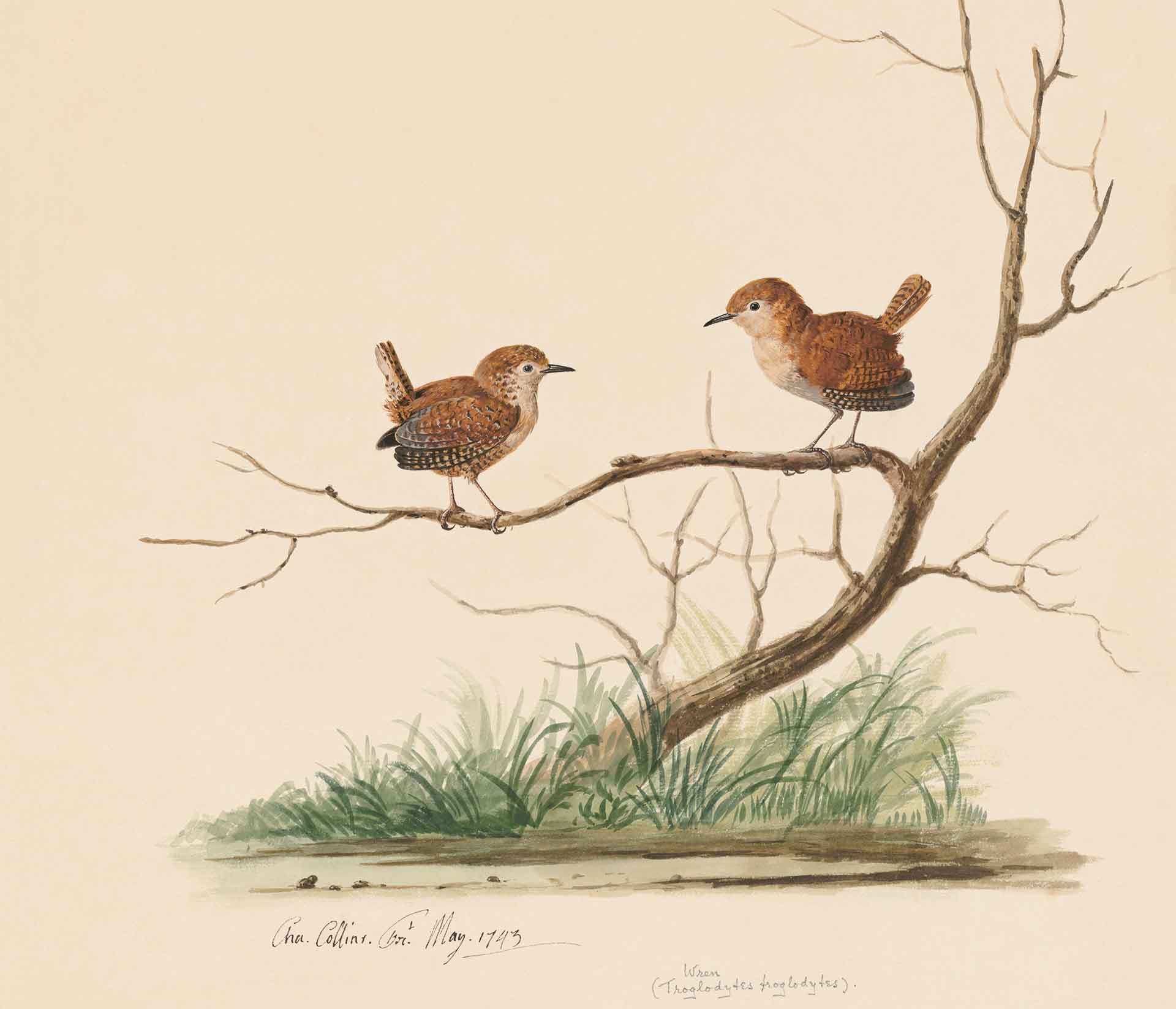
The Unlikely Sounding “Troglodytes Troglodytes”
Our young lurcher puppy, Lucy, was barking her head off in the middle of a large holly tree, which stands near the gate of our garden, in the small copse just outside. My husband could not get her to come out and she just continued on and on barking and setting off the neighbourhood dogs.
“Come out, Lucy”, I ordered rather too loudly for C’s liking, but enough eventually to be audible over the hound’s noisy intrusion.
“What was that all about?”, I asked.
“There is a wren’s nest in there”, came the reply.
I had not realised that wrens nest not only in trees, walls and hedges, but on the ground too, in protected places. Theoretically the centre of the holly bush should be a safe place - save for one sighthound’s extra keen sense of smell.
Co-incidentally the day before whilst baking in the car in the Tesco car park in our local town, I had watched with fascination 3 little wrens in the lower branches of the beech trees, which line the edge of the parking area.
Flitting from branch to branch I pondered whether they were newly fledged young or a threesome, as it is well known that Wrens sometimes practice polygamy!
They are astonishing little birds, who, despite losing a sizeable portion of their population in harsh winters, are thriving due to their twice yearly broods and the males, who sometimes have 4 or 5 families on the go at once.
They possess the most exquisite singing voices, whose volume is made all the more astounding by comparison to their tiny size. Their song is so unique that it can be easily identified amongst the dawn chorus, and I think that they must be amongst the earliest of the dawn sounds, which at this time of year starts around 3.50 am. The male and female are often to be heard in the most endearing duets, which bounce back and forth across the garden.
The wrens' nests are built in a dome like fashion, made of moss and twigs, and usually in hedges or openings in the walls and on the ground, as we discovered. Hence their Latin name Troglodytes Troglodytes which means “Cave dweller”, due to foraging for insects and larvae in dark crevices. They are known colloquially as “Kinglets” by the Germans and “wren” is originally from the Old German. The Greek name for them was Basileus - King - after the Aesop fable claiming that the king of the birds is the tiny bird that flew higher than the Eagle! I suspect there may be less truth in this than his story about “The Fox and the Grapes”.
John Dryden clearly knew of the fable:
Fool that I was, upon my eagle’s wings I bore this wren, till I was tired with soaring, and now he mounts above me.
Their size is clearly in inverse proportion to their lives and literary presence as well as musical talent!
Be The First
Join us to receive the latest news about our new rural writings & books
We will only ever send you messages in line with our Privacy Policy.
All content on this page is the copyright of Pippa White (unless otherwise stated) with all rights reserved worldwide. No portion of this content may not be used, under any circumstances, without written permission to use it from Pippa.