
Pippa White
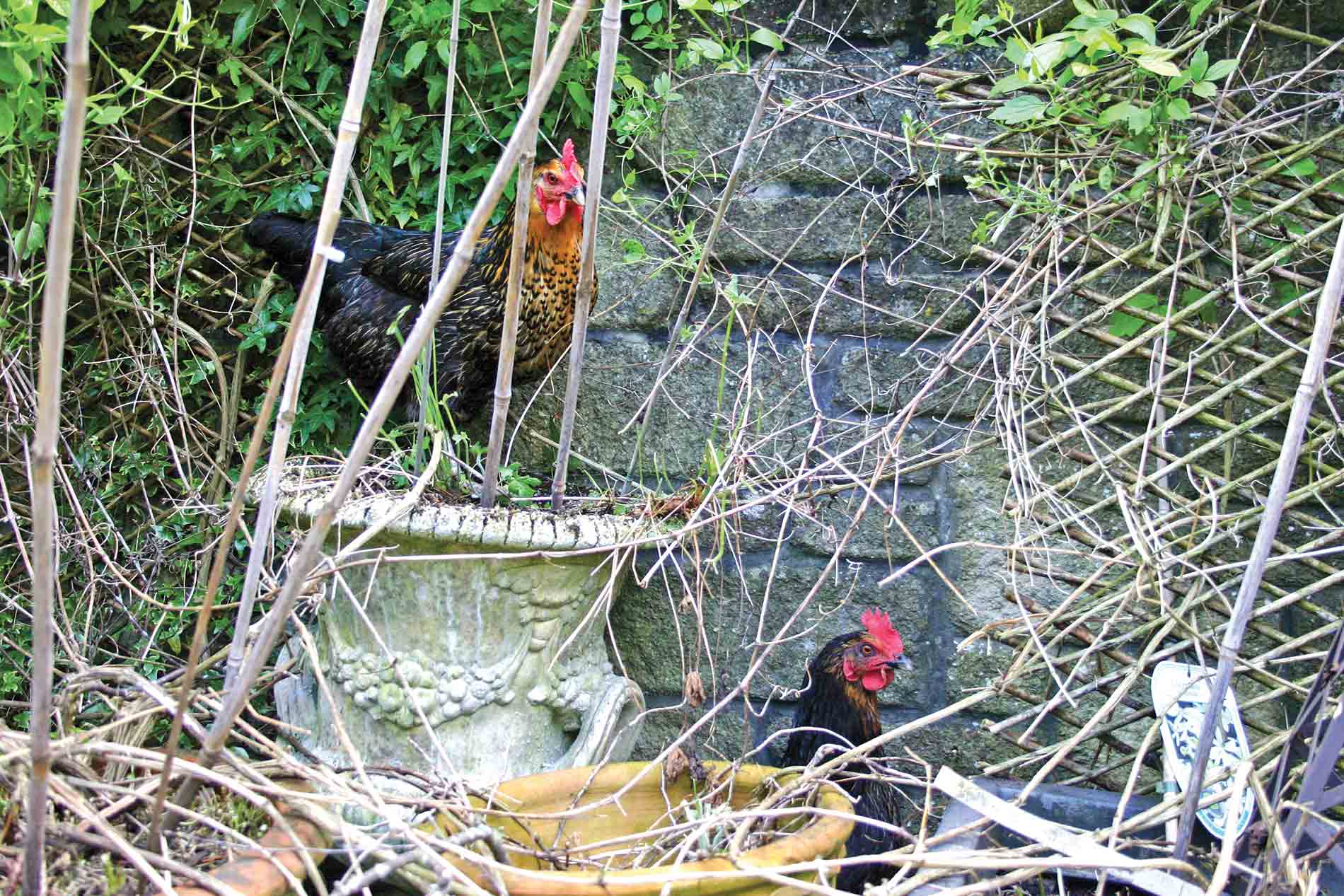
My most recent excursion into hen husbandry ended not in disaster, but in sadness. It began with great high spirits, as the Duchy Home Farm at Highgrove were off-loading some of their older layers, and so we hot-footed it up there to spend a little time chasing a couple of grand looking leghorn bantam crosses around pens sufficiently large to create enough area to make the game of catching them as long drawn out as possible.
Luckily there was a lovely stable girl to help, and so we duly rounded up two fearsome-looking ladies, and returned home in triumph, rejoicing in our cleverness at acquiring poultry of such provenance, without a penny exchanging hands.
We were clucking away to each other about what fun it was going to be, how wonderful to have our own eggs, chicken acreage requirements and so on (we have a tiny garden, however, that proved to be more than enough in terms of free range space for organic eggs). Quite mad as I might point out here that neither of us eat eggs, unless they are required in fish cakes or a homemade cake (which never happens as despite loving cooking I do NOT DO bake-off,) so the egg side of things was fairly redundant from the start.
Nevertheless, the following day, we returned to acquire two more of the lovely characters, as I had, in my ill-conceived wisdom, decided that they were a great embellishment to the garden with their beautiful plumage and really sweet bantam like chuckling and chortling and giggling.
We proudly installed our latest mad-cap acquisitions in their very smart hen house which had originally been part of a pair that graced the orchard at The Old Parsonage. Still patting ourselves on the backs, we decided to call them Deborah, Henrietta, Sarah and Hannah. Hannah is the name of the lovely stable girl.
It soon became clear that this experiment was going to go very wrong, for reasons I had not entirely anticipated. They were quite charming, easy on the eye, rubbed along together alright, laid beautifully, but they antagonised Ellie no end, until she actually got to the point she would refuse to go in to the garden, unless pushed. But, horror of all horrors and almost worse, they helped themselves to the plants….
And in what abundance…It is bad enough when Ells helps herself greedily to the lungwort every spring (to the extent I annually trawl Google to find out what possible benefit she could derive from consuming such quantities of this plant only to come to the reluctant conclusion that it possesses the same qualities for dogs as cat-nip for cats, namely it is hallucinogenic).
“Get that dog out of the lungwort!” comes the cry every spring, as hope springs eternal on the part of this little plant but yet again to be defeated by the lurcher’s obsessive nibbling. Actually as of writing, we are officially devoid of lungwort in the garden.
This cry was magnified on my part when I began to realise the enormity of my foolish fowl foray as daily I witnessed the onslaught of the slaughter of my beloved plants.
Now, in a very small garden you have very little space and so what space you have is then devoted by default to the very precious few plants you can place there, so one is extremely proprietorial about them. Which does not sit well with four hens, who are quite determined to eat the highest quality diet, despite all the grain and corn you give them, irrespective of the horticultural aesthetics.
Our little garden inevitably became a battle ground, with Deborah leading the charge, as quite the naughtiest, with Sarah never far behind. I sat it out for some time as the feathered additions to our life had their own particular charms. Over the course of that summer, I delighted in watching them run in that peculiar hen-like manner of ladies with long skirts, throwing their little legs out to the sides as they moved, witnessing the interesting social interactions between them, revelled in their generally sweet and low chuckling and for a while there was détente.
Henrietta, in particular, was a social creature who liked nothing better than to creep into the garden room very quietly, when the door was open and surreptitiously glide silently up to my legs, where I would be sitting working at the kitchen table. I would inevitably jump when I felt the unexpected brush of her feathers against my leg.
Now here, I must admit to a curious phobia which I have learnt over time to ignore: I hate handling hens of any type. I am fine with small and even larger birds such as house martins, or sparrows, or even hawks but for some reason I loathe the feeling of chickens. I have learned, for obvious reasons, to ignore this revulsion or fear, as I have generally been the hen herder of the family but it may stem from a time when I was seventeen and trying to earn a penny or two whilst I was still at school.
There was a chicken farm nearby and I was able to cycle there. It belonged to some neighbouring farmers who we had known a long time, and the deal was that I would help in the house, and when necessary pick the eggs from the hen houses for packing and market.
Hen houses is no accurate description for the hen hell I found myself in every Saturday morning (when I did not have school). The air was rank with the smell of death and decay, dusty with feathers, littered with weakened bodies that received no succour from the air and the sun, nor exercise nor movement, nor love nor care nor attention.
This was the first time I had been exposed to animals simply as a commodity; it was to be my last direct contact as such.
I grew up in a farming community where you knew personally the cows you milked and took to pasture, the ewes you lambed, even the piglets who ran through the orchard. The chickens were huge personalities and a necessary assassination of a particularly quarrelsome cockerel was always a sad matter.
But this…this was the first time I came face to face with the horrors of “factory farming”. It was horrid, cruel, dirty, nasty, crowded, dusty, smelly and, above all, totally undignified, both for the poor birds, but also I would argue for the farmers. What does it say about your values when you are prepared to sacrifice well-being, both animal and human, for mere profit?
The eggs were plentiful and totally insipid, the yolks a pale imitation of the deep almost bronzed yellow of the healthy bantam, the feathers dusty with neglect and their eyes were sunken in, for truly this was, and all farms like this are, the epitome of hell.
So, the phobia may have its roots in this early job, but found its outlet in giving future fowl the best care and love possible. The experience certainly lies at the root of my somewhat militant attitude towards food sources and the hi-jacking of the food supply, but the only thing we can do is put our wallets and our mouths where our heart is.
The clucking duchesses and Hannah in some way became an expression of that stance, but there was a limit.
They were the most highly destructive birds I had ever come across and for all their sweet natures, they pillaged, plundered and murdered their way through the garden plants, until the day I said to Christopher that we had to call a halt to this Good Life madness, despite the lovely eggs which were proving to be so popular with our friends.
The final straw was my beloved hellebores. The hellebores have been collected over 20 or so years. Despite losing some prized specimens along the way, it is still a reasonable collection, particularly of some doubles which I have grown since they were plugs and which took three years to flower.
Every Christmas I am rewarded by the single pure white Christmas Rose that puts its head well above the parapet long before the rest of the plant. The Christmas Rose, in my long experience, usually flowers at Easter-time more often than not. These hardy plants delight for nearly six months of the year for so little trouble, and yet I think they are some of the most beautiful and varied species in the world. When the chickens decided hellebores were fair game, it was war.
Having been through every annual seedling they could get their little beaks at, including to my fury, the borage, they made dirt baths of every flower bed. After they had woven tunnels and openings through the box hedges so carefully nurtured over the years, attacked the herbs, squabbled with each other, refused to lay in the hen house and generally made the most massive mess and nuisance of themselves, it was time to move on.
Well not quite, it was exile, down the road to some very nice neighbours, who already had a large group of feathered friends. I fear they did not last very long, and the garden was very quiet without them, and perversely, of course we missed them, but it was a salutary lesson that expectations do not always meet aspiration. Hens are only really suited to large spaces, and they are definitely not suited to cramped, confirmed and unhappy quarters. My latest foray was probably to assuage some of the guilt I felt from “picking eggs” for money, but at least this paved the way for a more humane sensibility of our feathered friends. Our charming but naughty feathered friends are much missed but fondly remembered.
Be The First
Join us to receive the latest news about our new rural writings & books
We will only ever send you messages in line with our Privacy Policy.
All content on this page is the copyright of Pippa White (unless otherwise stated) with all rights reserved worldwide. No portion of this content may not be used, under any circumstances, without written permission to use it from Pippa.